What Happens to Your Body When You Stand Among Ancient Redwoods
The Moment the Forest Starts Working on You
Most people notice it within the first twenty minutes. The shoulders drop. The jaw unclenches. Breathing slows down without any conscious effort, like the body remembered something it had forgotten. Standing beneath the towering coastal redwoods of Big Sur — some of them older than the Roman Empire — guests at our sanctuary describe a feeling that's hard to put into words. Not quite calm. More like coming home.
That sensation isn't just poetry. It's physiology. And researchers have spent the last few decades trying to understand exactly what's happening inside the human body when we enter an old-growth forest.
Shinrin-Yoku: A Practice With Deep Roots
The Japanese coined the term shinrin-yoku in the 1980s — literally translating to "forest bathing" or "taking in the forest atmosphere." It wasn't designed as exercise or even meditation. It was developed as a public health response to a burnout epidemic sweeping Japan's urban centers, and it worked spectacularly well.
Dr. Qing Li, one of the world's leading researchers on forest medicine and author of Forest Bathing: How Trees Can Help You Find Health and Happiness, has documented some remarkable findings. In controlled studies, participants who spent two to three hours walking slowly through forested environments showed measurable drops in cortisol levels — the body's primary stress hormone — compared to those who walked the same duration in urban settings. Heart rate variability improved. Blood pressure normalized. And perhaps most surprisingly, natural killer (NK) cell activity — a key marker of immune function — increased significantly and, in some studies, remained elevated for up to thirty days after a single forest visit.
Thirty days. From one afternoon in the trees.
The mechanism behind this immune boost has a lot to do with something called phytoncides. These are antimicrobial compounds that trees — particularly conifers like redwoods, cedars, and pines — naturally emit to protect themselves from insects and disease. When we inhale them, our bodies respond. NK cells multiply. Stress hormones recede. The parasympathetic nervous system — the "rest and digest" mode that modern life keeps overriding — finally gets a chance to run the show.
Why Big Sur Is Different
Here's the thing: not all forests are created equal, and Big Sur's particular alchemy of ecosystem is worth talking about honestly.
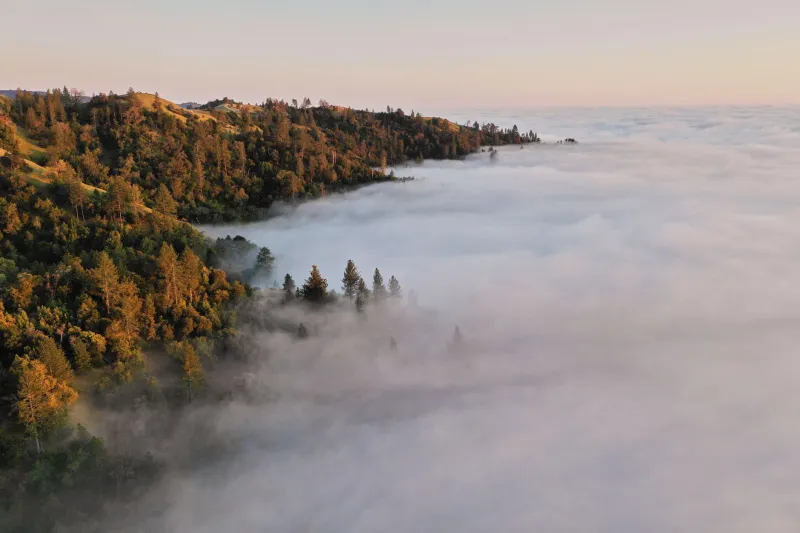
The coastal redwoods (Sequoia sempervirens) that grow in the canyons and ridgelines here are the tallest living organisms on Earth. They thrive in a narrow fog belt along California's coast, drawing moisture from the marine layer that rolls in off the Pacific almost every morning. That fog — thick, cool, and saturated — carries with it negatively charged ions from the ocean. Research from institutions including Columbia University has linked negative ion exposure to improved mood, reduced fatigue, and lower rates of depression.
So when you're standing in a Big Sur canyon at dawn, you're simultaneously breathing phytoncides from the trees, negative ions from the ocean air, and oxygen at concentrations that are measurably higher than what you'd find in a city. The sensory input is also dramatically different — birdsong, moving water, wind through ferns — which research in environmental psychology shows activates what's called involuntary attention, a restful mental state that allows the prefrontal cortex to recover from decision fatigue.
In other words, the environment does the work for you.
"I've done breathwork retreats, plant medicine ceremonies, years of therapy," said Marlena, a guest who visited our sanctuary from Chicago last fall. "I wasn't expecting a hike to do anything I hadn't already done. But I sat down at the base of this massive redwood and started crying — not sad crying, just like something releasing. I stayed there for two hours. I've never felt so clean inside."
Her experience isn't unusual. We hear versions of it regularly.
How to Actually Practice Forest Bathing (Not Just Hiking)
This is where most people get it wrong. Forest bathing is not a hike. It's not a trail run. It's not even a nature walk with headphones in. The practice requires slowness — and that's the hardest part for most Americans, who've been conditioned to optimize every outdoor experience for distance, elevation gain, or calorie burn.
Here's a simple framework to get started, whether you're in Big Sur or your nearest state park:
Leave the agenda behind. Set a time limit (two hours is ideal) rather than a distance goal. The point is absorption, not achievement.
Engage all five senses deliberately. Pause and notice what you can hear at this exact moment. What does the bark feel like under your palm? What's the temperature difference between sun and shade? Sensory presence is the gateway into the physiological benefits.
Sit more than you walk. Find a spot that draws you — not because it's scenic, but because something about it feels right — and stay there. Let the forest come to you.
Go device-free. This one's non-negotiable. The research on forest bathing almost universally controls for smartphone use because even the presence of a device activates anticipatory anxiety and keeps the nervous system in a low-grade alert state.
Try a solo sit. Fifteen to thirty minutes of sitting alone in stillness, without any agenda, is one of the most powerful and underrated practices in nature-based wellness. Many guests at Big Sur Spirit Garden describe their first solo sit as the moment the forest "opened up."
The Bigger Picture
There's something quietly radical about the forest bathing movement. In a wellness culture that often defaults to more — more supplements, more sessions, more optimization — shinrin-yoku asks us to simply stop and receive. To trust that nature has already built the medicine. That our bodies, when given half a chance, know exactly what to do with it.
Big Sur has been holding this medicine for millennia. The redwoods were ancient before California was a state, before European contact, before most of what we call civilization took root. They've seen droughts, fires, floods, and they're still here — rooted, patient, exhaling.
Maybe the most healing thing we can do is show up and let them do their work.