Dark Is Not Broken: How Big Sur's Winter Teaches Your Body to Finally Rest
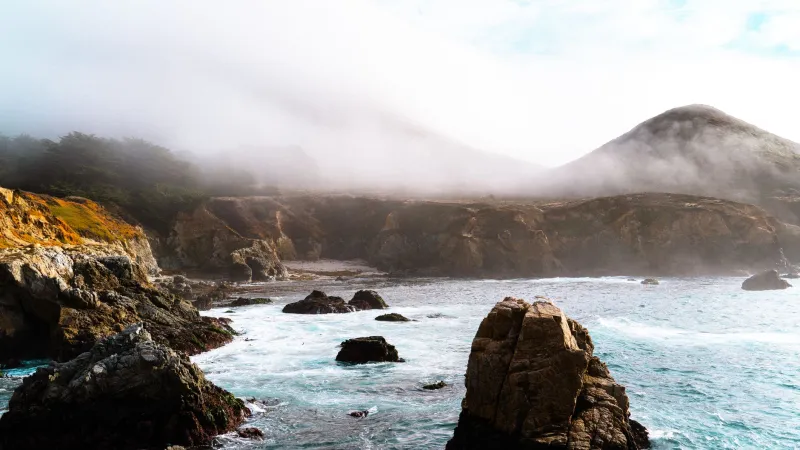
Somewhere along the way, the wellness industry decided healing looks like golden hour. Bright light, warm skin, a smoothie in hand, a hike with a view. And sure — summer at Big Sur is magnificent. But if you've ever stood here in January, watching the fog sit heavy over the ridge at 8 a.m., feeling the cold settle into your coat like a slow exhale, you might have sensed something that the highlight-reel version of wellness never mentions.
This feels like medicine too.
It is.
What Wellness Culture Gets Wrong About Light
We've been conditioned to treat darkness as a problem to solve. Seasonal affective disorder, winter blues, the general cultural anxiety that kicks in around November — these are real experiences, and they deserve real care. But the response to winter darkness has largely been to fight it: light therapy boxes, vitamin D megadoses, booking flights south, filling the calendar so the quiet doesn't get too loud.
What if that instinct — the one that keeps us chasing brightness year-round — is actually part of what's exhausting us?
Human biology didn't evolve under perpetual sunshine. It evolved through seasons. And winter, with its longer nights and muted days, was never meant to be overcome. It was meant to be inhabited.
Big Sur in Winter: What the Land Is Actually Doing
If you've visited this stretch of California coast in the warmer months, you know the drama of it — the cliffs, the turquoise water, the way everything feels almost aggressively alive. Winter here is something else entirely. The light comes later and leaves earlier. Fog rolls in from the Pacific and doesn't always burn off by noon. The hills go deep green from the rains. The crowds thin out. The silence gets bigger.
And the land, in its own way, slows down.
That slowing is not incidental. It's instructional. The coastal scrub and redwood groves aren't hibernating in a broken way — they're cycling through a phase of consolidation, root-deepening, quiet preparation. The land isn't waiting for spring to start mattering. It's doing some of its most essential work right now, underground and out of sight.
Your nervous system, given half a chance, will do the same.
The Biology of Winter Darkness
Here's what actually happens in your body when darkness arrives earlier and stays longer — assuming you're not fighting it with screens and artificial light until midnight.
Melatonin production increases. Not just the kind that makes you sleepy, but the kind that functions as a powerful antioxidant, supports immune regulation, and signals to every cell in your body that it's time to repair. Melatonin doesn't just help you sleep — it orchestrates a whole cascade of restorative processes that your body can only run when it's not in active, alert mode.
At the same time, the parasympathetic nervous system — the branch responsible for rest, digestion, tissue repair, and emotional processing — gets more opportunity to run the show. When we're not constantly stimulated, not pushing through long bright days with packed schedules, the body naturally downshifts into the mode it needs to actually heal.
Cortisol rhythms, when allowed to follow natural light cues, become more regulated in winter. The sharp morning spike softens. The slow evening decline actually happens. For people who spend most of the year in a state of low-grade cortisol dysregulation — which, honestly, is most of us — this seasonal recalibration can feel almost shockingly restorative.
This isn't a theory. Chronobiology research has consistently shown that light exposure patterns directly regulate the hypothalamic-pituitary-adrenal axis — the system that governs stress response. Winter's shorter photoperiod, when honored rather than artificially overridden, gives that system a genuine break.
What It Feels Like to Stop Fighting the Season
People who come to Big Sur in January often describe something unexpected. They came for the scenery, or maybe they just needed to get away, and they weren't sure what to expect from an off-season visit. What they find, sometimes to their surprise, is that the muted version of this place hits differently.
The fog makes the coastline feel more intimate. You're not looking out at an infinite horizon — you're enclosed, held, wrapped. The cold makes you slow your walk. The early dark makes dinner feel like an event, and sleep feel earned. Without the pressure to maximize every sunny hour, something loosens.
That loosening? That's your parasympathetic nervous system finally getting a word in.
How to Bring Winter's Medicine Home
You don't have to be standing on the Big Sur coast to let winter do its work. The principles are portable, even if the scenery isn't.
Stop fighting the dark. Dim your lights in the evening. Let the shorter days actually be shorter for your body. This single shift — reducing artificial light exposure after sunset — can meaningfully improve melatonin production and sleep quality within a week or two.
Reframe slowness as productivity. Winter is when the nervous system wants to process, consolidate, and repair. The cultural pressure to maintain summer-level output through December and January is genuinely harmful. Rest isn't laziness — in winter, it's physiology.
Spend time outside in the gray. Even overcast winter light contains full-spectrum cues your circadian system needs. Fifteen minutes outside in the morning, even on a cloudy day, helps anchor your body's internal clock in ways that indoor light simply cannot replicate.
Let the cold be information. A brief exposure to cold air — a walk without a heavy coat for a few minutes, a cooler morning shower — activates brown adipose tissue, supports mitochondrial function, and signals the body that the season is real. You don't have to be uncomfortable. Just present.
Create genuine stillness. Not the performative stillness of a meditation app with ambient rain sounds, but actual quiet. Winter is the season for it. Let there be evenings with no agenda, no content, no productivity. Just the dark, and whatever surfaces in it.
The Gift Hidden in the Mist
Big Sur's winter doesn't ask you to be okay with it. It doesn't perform. The fog doesn't lift on cue, the sun doesn't always appear, and the coast can feel genuinely austere. But there's a kind of honesty in that, and the body recognizes it.
We spend so much of the year managing our experience — optimizing, brightening, scheduling, stimulating — that we've nearly lost the ability to simply be in a season that asks us to go inward. Winter darkness isn't a deficit. It's an invitation.
The nervous system's favorite season isn't the one with the best Instagram light. It's the one that finally gives it permission to rest.
And out here on the coast, the fog has been extending that invitation for a very long time.