Forget the Finish Line: How Pilgrimage-Style Walking on the Big Sur Coast Changes Your Entire Sense of Time
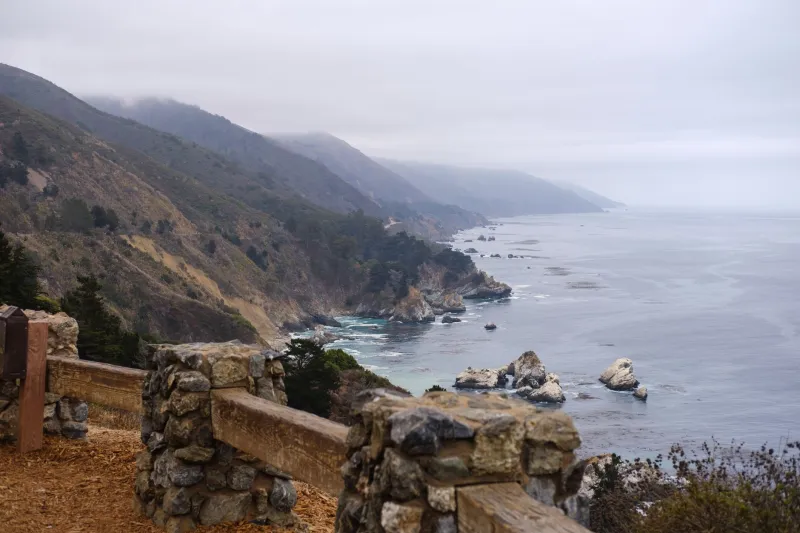
Somewhere between the first mile and the second, something starts to loosen. Not your muscles — though that too — but something deeper. The part of your brain that's been tracking minutes, meetings, and miles-per-hour starts to go a little quiet. The fog is doing its thing off the cliffs. The switchgrass is bending in the wind. A hawk is just... circling. And suddenly you realize you have no idea what time it is, and more surprisingly, you don't actually care.
That's not distraction. That's medicine.
Big Sur's coastal trail isn't particularly famous for being easy or fast. It's famous for being present. The terrain demands it — uneven switchbacks, sudden ocean views that stop you cold, redwood corridors that swallow sound whole. You can't really power-walk your way through Big Sur without missing the entire point of being there. And that friction, that gentle insistence from the land itself that you slow down, turns out to be one of the most neurologically significant things a human body can experience in the modern world.
The Productivity Trap We Brought Into the Wilderness
Here's the uncomfortable truth: most of us hike the same way we work. We set a destination, we track our pace, we measure elevation gain, we post the summit selfie. Even our leisure has been colonized by the logic of output. Fitness apps reward us for going faster. Hiking guides are organized by difficulty ratings. We bring the finish line with us everywhere we go.
This isn't a personal failing — it's a cultural one. American productivity culture has spent decades teaching us that time is a resource to be optimized, not a dimension to be inhabited. The result is a baseline relationship with time that's almost entirely future-oriented. We're always moving toward something, which means we're rarely fully in anything.
And our nervous systems are paying the price. Chronic time pressure — even the low-grade, ambient kind — keeps the body's stress response partially activated. Cortisol stays elevated. The prefrontal cortex stays in planning mode. Real rest, the kind that actually restores you, requires a fundamentally different relationship with time than the one most of us are walking around with.
What Pilgrimage Actually Means
The concept of pilgrimage is older than most organized religion. Across cultures — from the Camino de Santiago to the Kumano Kodo trail in Japan to Indigenous walking routes throughout the Americas — humans have understood that slow, intentional movement through sacred landscape does something that ordinary travel doesn't. It changes the walker.
The key word there is intentional. Pilgrimage-style walking isn't aimless wandering, and it isn't athletic training. It's a middle path: purposeful but unhurried, directional but not destination-obsessed. The journey itself is the practice. Every step is the point.
Big Sur has always functioned this way for the people who've known it best. The Esselen people, whose ancestral territory this land belongs to, understood this coastline as a living, sacred system — not a backdrop for recreation, but a presence to be moved through with respect and attention. That orientation toward the land isn't just spiritual philosophy. It's a completely different relationship with time and pace, one that modern wellness culture is slowly, haltingly beginning to remember.
What's Actually Happening in Your Brain
Neuroscience has some genuinely fascinating things to say about slow, immersive walking in natural environments. Research on what's called "soft fascination" — the kind of low-intensity, effortless attention that natural landscapes naturally invite — shows that it activates the brain's default mode network in ways that goal-directed activity simply doesn't. This is the same network associated with creativity, emotional integration, and what psychologists call "autobiographical processing" — the brain's way of making meaning out of experience.
In plain terms: when you stop trying to accomplish your walk, your brain starts doing some of its most important work.
There's also compelling research on how natural environments alter time perception. Studies have found that time spent in green and blue spaces — forests, coastlines, open sky — consistently leads people to underestimate elapsed time. They feel like less time has passed than actually has. That's not a bug. That's the body dropping out of its chronic urgency state and into something closer to what researchers call "psychological richness" — a mode of experience that feels full and meaningful rather than rushed and thin.
Big Sur's specific geography amplifies this effect. The scale of the landscape — the vertiginous cliffs, the vast Pacific, the ancient redwood groves — creates what environmental psychologists call "awe," and awe has been shown in multiple studies to physically expand people's perception of time. You feel like you have more of it. That feeling isn't an illusion. It's your nervous system recalibrating.
How to Actually Walk This Way
You don't need a week-long retreat or a specific trail certification to practice this. You need intention and a willingness to feel a little inefficient.
Leave the fitness tracker at the trailhead. Or at least, stop looking at it. The moment you're monitoring pace, you've re-entered productivity mode. Give yourself permission to move without data.
Choose a direction, not a destination. Pick a general heading — toward the water, into the canyon, along the ridge — without committing to a specific endpoint. Let the trail tell you when you've gone far enough.
Stop every time something stops you. Not because you should, but because something in you wanted to. That hawk. That particular way the light is hitting the fog. The smell of sage after rain. These aren't interruptions to the walk. They are the walk.
Notice when you're rushing and ask why. Sometimes the urge to pick up pace is just habit. Sometimes it's anxiety looking for a physical outlet. Either way, it's worth pausing for a second to feel it before you act on it.
Let the landscape set the rhythm. Big Sur's trail has its own tempo — it speeds up on open ridgelines, slows in dense redwood shade, pauses at every overlook. Following that rhythm instead of imposing your own is the whole practice.
The Thing Nobody Tells You About Slowness
Slowing down feels counterintuitive in a culture that treats speed as virtue. It can even feel vaguely irresponsible, like you're wasting time. But here's what actually happens when you do it long enough: time stops being something you're running out of and starts being something you're in.
That shift — from scarcity to inhabitation — is one of the most profound things a body can experience. It's what pilgrims across centuries have been chasing. It's what the land at Big Sur has been quietly offering all along.
You don't have to earn it. You just have to stop trying to get there faster.