What the Forest Floor Already Figured Out: Lessons in Collective Healing from Big Sur's Fungal Web
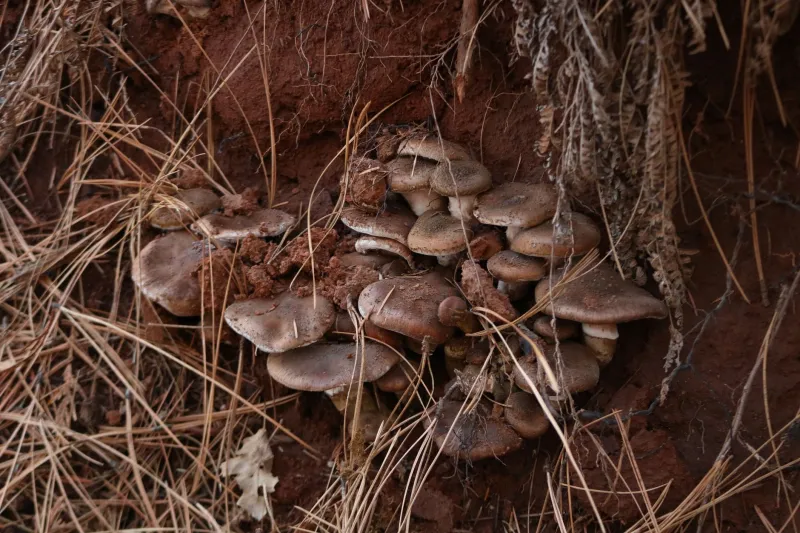
You're walking a trail in Big Sur — maybe somewhere in the Ventana Wilderness, maybe along the shadowy understory near Pfeiffer Big Sur State Park — and you're thinking about how quiet it is. How still. How separate everything looks: this tree over here, that fern over there, a redwood standing alone against the fog.
Except none of it is alone. Not even close.
Just a few inches beneath your boots, something extraordinary is happening. A sprawling, living network of fungal threads — called mycelium — is threading itself through every handful of soil, connecting root to root, tree to tree, organism to organism. It's passing nutrients. It's sending chemical signals. It's redistributing resources from the strong to the struggling. It's been doing this for hundreds of millions of years, long before humans started building wellness apps and optimization routines.
And honestly? It might be the most radical healing model we've ever ignored.
The Wood Wide Web, For Real
You've probably heard the phrase "wood wide web" — the popular shorthand for mycorrhizal networks, the fungal partnerships that link the root systems of most land plants. But even if you've seen the headlines, the actual mechanics of it are worth sitting with for a minute, because they're kind of mind-blowing.
Mycorrhizal fungi form symbiotic relationships with plant roots, essentially extending the reach of a tree's root system by orders of magnitude. In exchange for sugars the plant produces through photosynthesis, the fungi deliver water, phosphorus, nitrogen, and other nutrients the plant can't easily access on its own. It's a trade. A relationship. A form of mutual investment that neither party could thrive without.
But it doesn't stop at one-on-one exchanges. These networks create something closer to a community infrastructure. Older, more established trees — sometimes called "mother trees" by researchers like the late Suzanne Simard, whose work transformed how we understand forest ecology — actively funnel carbon and nutrients toward younger, weaker seedlings growing in their shade. Trees that are stressed or dying sometimes release their stored resources back into the network before they go, a kind of ecological generosity that looks, if you're willing to say it, a little like care.
In Big Sur's mixed conifer and redwood forests, this underground collaboration is happening at massive scale. The ecosystem you see above ground — the towering trunks, the layered canopy, the improbable richness of life in a place constantly battered by wind and fog and salt — is in large part a product of what's happening invisibly below it.
Your Brain Is Also a Network
Here's where this gets personal.
The structure of a mycelial network — decentralized, redundant, adaptive, constantly routing information through multiple pathways — looks remarkably similar to the structure of your nervous system. Your brain, too, is not a command center issuing orders from the top down. It's a web of billions of neurons, constantly forming and reforming connections, rerouting signals when one pathway gets blocked, learning through relationship and repetition rather than through isolated effort.
Neuroscientists have spent decades studying how trauma, stress, and disconnection literally reshape neural architecture — how isolation prunes away pathways that connection would keep alive. The research on loneliness, for instance, shows that chronic social disconnection doesn't just feel bad. It changes the brain at a structural level, in ways that mirror the kind of damage we see in ecosystems that have been stripped of their fungal networks.
Conversely, social connection, co-regulation, and felt safety — the sense that you are part of something larger than yourself — support the kind of neural flexibility that underlies healing, creativity, and resilience. Your nervous system, like the forest floor, does its best work in relationship.
This isn't a metaphor. It's biology.
What Wellness Culture Gets Wrong About the Self
American wellness culture has a serious individualism problem. We talk about healing as something you do in private — your practice, your journey, your transformation. We track our personal metrics, optimize our personal routines, and measure progress by how much better we feel as individuals.
And look, personal practice matters. Meditation, breathwork, time in nature — these things genuinely shift your physiology. We're not dismissing any of that.
But the mycelial model suggests something the self-help industrial complex tends to leave out: that you cannot fully heal in isolation. That your wellbeing is structurally entangled with the wellbeing of the people and places around you. That trying to optimize yourself as a standalone unit, cut off from community and ecosystem, is a bit like trying to grow a healthy tree in soil that has no fungal network — technically possible under controlled conditions, but missing something essential.
Big Sur has a way of making this viscerally obvious. When you spend real time here — not just a day trip, but actual immersive time — you start to feel the interconnection that's harder to access in urban environments. The fog connects the ocean to the redwoods. The redwoods feed the soil. The soil feeds the fungi. The fungi feed the trees. Everything is in conversation. Nothing is optimizing itself in isolation.
That feeling isn't just poetic. It's information.
How to Think Like Mycelium
So what does it actually look like to bring this framework into your healing practice? A few starting points:
Redistribute rather than hoard. Mycelial networks move resources toward where they're most needed, not just toward the strongest nodes. In your own life, this might mean asking who in your community is depleted right now, and what you have to offer — not because it's virtuous, but because the network functions better when it circulates.
Invest in your connection points. The health of a fungal network depends on the quality of its junctions — the places where threads meet and exchange. Your relationships, your community spaces, your shared rituals are those junctions. They deserve as much attention as your personal practices.
Trust the slow, underground work. Mycelium doesn't perform. It moves quietly, incrementally, largely out of sight. Healing often works the same way. The most significant shifts — in nervous system regulation, in relationship to self and others — often happen below the surface, over time, without dramatic visible markers.
Let dying things feed what's growing. One of the most striking things about fungal networks is how they metabolize endings. Decay isn't failure in this system — it's redistribution. The grief, the loss, the things you're releasing? They have somewhere to go. They can become nutrients for what comes next.
The Ground You're Standing On
If you ever get the chance to spend time in Big Sur's forests — really spend time, sitting still long enough for the place to stop performing and start just being — pay attention to the ground beneath you. Not just as dirt, but as a living system that has been practicing interconnection for longer than our species has existed.
The fungi don't need us to understand them to keep doing what they do. But there's something available to us in the understanding, a kind of reorientation that the modern wellness world badly needs.
You are not a self-contained unit optimizing toward peak performance. You are a node in a network, shaped by your connections, dependent on exchange, most fully yourself when you're in genuine relationship with the living world around you.
The forest floor already figured this out. We're just catching up.