Your Nervous System Already Knows: The Science of Why Big Sur Heals You From the Inside Out
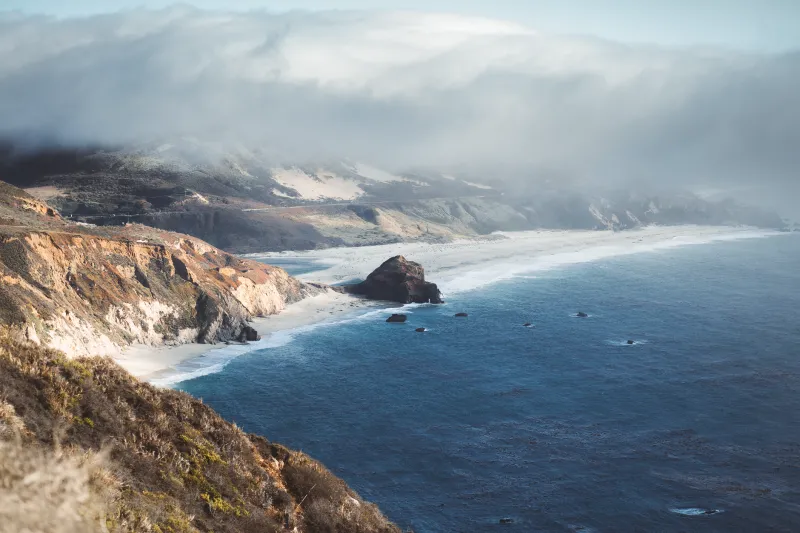
You pull over on Highway 1 somewhere south of Carmel. The Pacific is doing that thing it does — enormous, steel-gray, completely indifferent to you. And something in your chest just... loosens. You didn't plan for it. You weren't trying to heal anything. But your body went ahead and started the process without asking permission.
That's not poetry. That's physiology.
Over the past decade, researchers in environmental psychology, neuroscience, and integrative medicine have been quietly building a case for what coastal communities and Indigenous peoples have understood for centuries: certain landscapes don't just make us feel better. They change us biologically. And Big Sur, with its particular combination of dramatic elevation, crashing surf, dense coastal fog, and ancient geology, appears to be one of the most potent natural environments for triggering those changes.
The Ion Conversation Your Cells Are Having Without You
Let's start with something invisible. The air near breaking ocean waves is dense with negatively charged ions — molecules that carry an extra electron, generated when water molecules collide violently with rock and air. Big Sur's coastline, where waves routinely slam into 100-foot cliffs, is essentially a negative ion factory.
Negative ions have been studied since the 1930s, but recent research has sharpened our understanding of what they actually do in the body. A 2018 meta-analysis published in BMC Psychiatry found significant evidence linking negative air ionization to reduced symptoms of depression and seasonal mood disorders. The proposed mechanism involves serotonin — specifically, negative ions appear to influence serotonin oxidase activity, which affects how much of this mood-regulating neurotransmitter stays available in the brain.
For visitors to our garden and retreat space here on the coast, this translates to something practical: even passive time spent near the ocean — sitting, watching, breathing — is delivering a low-level neurochemical intervention. Your body is being nudged toward calm before you've done a single meditation.
When Your Circadian Rhythm Finally Syncs
Most of us are walking around in a state of chronic circadian disruption. Blue-light screens, artificial lighting, irregular sleep schedules, and the relentless stimulation of modern work culture have collectively severed our internal clocks from the natural light-dark cycles they evolved to follow.
Big Sur has almost no light pollution. Fog rolls in at dusk. The sun sets over open ocean with nothing to interrupt it. And the rhythm of the place — loud in the morning with birdsong and wind, quieting toward evening — is exactly the kind of environmental cueing that helps reset the hypothalamic-pituitary axis, the brain region responsible for regulating cortisol, melatonin, and sleep timing.
Dr. Qing Li, a researcher at Nippon Medical School and author of Forest Bathing, has documented how natural light exposure in wilderness settings can normalize cortisol curves within 48 to 72 hours. Guests who spend even a long weekend here often report sleeping more deeply than they have in years — not because the beds are fancy, but because their bodies are finally receiving the environmental signals they've been starved of.
The Psychology of Awe — and Why It's Not Optional Anymore
There's a specific emotional state that researchers Dacher Keltner and Jonathan Haidt defined in a landmark 2003 paper: awe. It's what you experience when confronted with something so vast or complex that it temporarily short-circuits your ordinary sense of self. Keltner's subsequent work at UC Berkeley found that awe — particularly awe triggered by natural environments — measurably reduces inflammatory cytokines in the body, shrinks the psychological phenomenon known as the "default mode network" (the mental chatter loop), and increases prosocial behavior.
Big Sur is, bluntly, one of the most awe-inducing landscapes on the North American continent. The vertical drop from ridge to sea. The fog that makes the redlines disappear. The way a whale breach 400 yards offshore can make a group of strangers suddenly turn to each other, speechless. These aren't tourist experiences. They're neurological events.
Visitors to our retreats regularly describe a version of the same thing: a sense that their problems became temporarily smaller — not because the problems disappeared, but because the scale of the landscape provided genuine perspective. That perceptual shift has downstream effects. Rumination decreases. Presence increases. The body, no longer locked in threat-response mode, begins doing the repair work it's been postponing.
What the Research Still Can't Fully Explain
Here's where we want to be honest with you: science is catching up to something that lived experience has known for a long time, but it isn't there yet. The studies on negative ions, awe, and circadian reset are real and growing — but they're also often small-scale, and the mechanisms are still being debated.
What we can say, from years of hosting retreats in this landscape, is that the convergence of factors here seems to matter. It's not just the ocean. It's not just the trees. It's the particular combination of salt air, extreme topography, relative quiet, and the sense — hard to articulate but impossible to miss — that this land has been holding people for a very long time.
Several guests have described the experience using almost identical language: I didn't realize how wound up I was until I wasn't anymore.
That unwinding is the thing. And while we love a good neuroscience paper as much as the next wellness site, we also think there's wisdom in simply trusting the body's response. Your nervous system knows what it needs. Sometimes you just have to get it somewhere with crashing waves and no Wi-Fi and let it do its work.
How to Let the Landscape Actually Work on You
If you're planning time in Big Sur — whether as part of a structured retreat or a personal trip — a few practical notes from what we've observed:
Arrive without an agenda for at least the first few hours. The temptation to immediately hike, photograph, or "do" something is real. Resist it. Sit near the water. Let the transition happen.
Limit screen time, especially in the morning. Those circadian reset benefits require you to actually receive the natural light cues. The phone can wait.
Go outside after dark. Even five minutes under a genuinely dark sky does something to your sense of scale that's hard to manufacture any other way.
Notice what you notice. The healing here isn't passive in the sense of being effortless — it requires a certain quality of attention. The landscape will meet you halfway, but you have to show up.
Your nervous system has been waiting for this. It turns out, it knew where it wanted to go all along.