What the Waves Already Know: How Big Sur's Ocean Rhythms Reset Your Stress at the Cellular Level
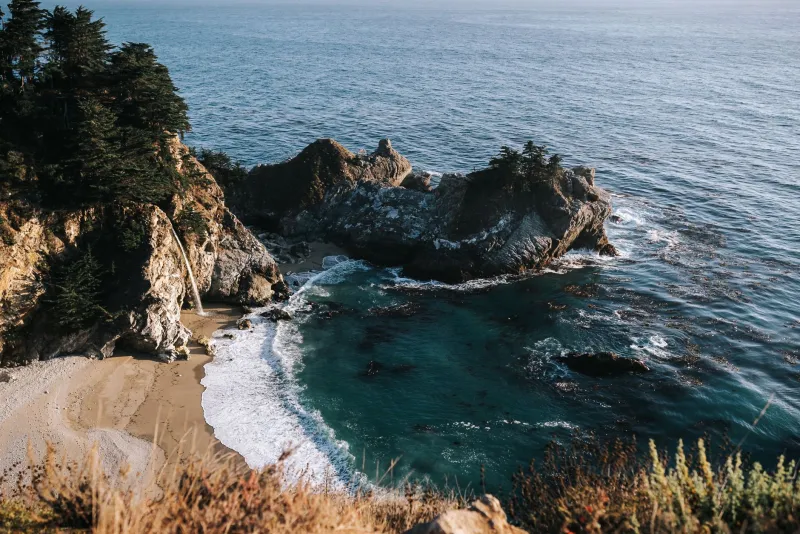
Something happens when you sit on a rock above the Pacific at Big Sur and let the waves do their thing. Your shoulders drop. Your jaw unclenches. You stop rehearsing that difficult conversation from Tuesday. Most wellness writing chalks this up to "the ocean is relaxing" and moves on. But that explanation is doing a disservice to what's genuinely one of the more fascinating intersections of ecology and human neurobiology happening in real time on this coastline.
Because here's the thing: your body isn't just enjoying a view. It's being actively reorganized.
Your Nervous System Is Listening
Let's start with sound, because it's doing more work than most people realize. Ocean waves at Big Sur don't just crash — they crash rhythmically, in patterns that researchers have found to hover around 0.1 Hz in frequency. That number matters because it closely aligns with the natural oscillation of your cardiovascular system, a phenomenon called heart rate variability (HRV). When external rhythmic stimuli sync with your body's internal rhythms, something called entrainment occurs. Your nervous system essentially follows the beat.
This isn't metaphor. Studies in environmental psychology have shown that natural, rhythmically patterned sounds — particularly ocean wave sequences — activate the parasympathetic branch of the autonomic nervous system. That's the rest-and-digest side of the equation, the biological counterweight to fight-or-flight. Activation here means your heart rate slows, your digestion eases, and your prefrontal cortex — the part of your brain responsible for rational thought and emotional regulation — comes back online after stress has pushed it offline.
Big Sur's coastline is particularly effective at this because the wave patterns here aren't uniform. The underwater topography along this stretch of the Central California coast creates layered, complex wave sets. You get the big crash, then the hiss of retreat, then smaller secondary swells. That layering produces what audio researchers call "pink noise" — a sound spectrum that's been shown in sleep and focus studies to be more cognitively soothing than either total silence or white noise. Your brain reads it as safe. Ancient, even.
Sea Spray Is Actually a Delivery System
Now let's talk about what you're breathing. When waves break against the rocks at Big Sur, they atomize seawater into an aerosol mist that carries something genuinely interesting: negative ions. These are oxygen molecules with an extra electron, produced in abundance wherever water moves vigorously — waterfalls, rivers, and especially coastlines with heavy surf.
Negative ion exposure has been studied in clinical contexts for its effects on mood and stress hormones. Research published in journals including the Journal of Alternative and Complementary Medicine has found that high-density negative ion environments correlate with reduced salivary cortisol — that's the primary stress hormone your body pumps out when it perceives threat. Lower cortisol means your body can begin the actual work of recovery and repair that chronic stress perpetually delays.
The negative ion concentration along Big Sur's coast, particularly on days with strong onshore wind and active surf, is among the highest measurable in any natural environment in the continental US. You're not just watching the ocean. You're inhaling it, and it's talking directly to your endocrine system.
Trauma, the Vagus Nerve, and Why This Matters Beyond Relaxation
For people carrying trauma — and that's most of us, in varying degrees — the coastal environment offers something more specific than generic calm. Trauma lives in the body as a dysregulated nervous system. Polyvagal theory, developed by neuroscientist Dr. Stephen Porges, describes how the vagus nerve acts as a kind of internal safety detector, constantly scanning the environment for cues of danger or safety. When it finds safety, vagal tone improves — and with it, your capacity for social connection, emotional regulation, and physiological resilience.
Ocean environments are exceptionally rich in what Porges calls "neuroceptive cues of safety." The rhythmic sound we already discussed. The open horizon (no predators approaching unseen). The cool, moist air that triggers a mild calming of the trigeminal nerve. The physical sensation of wind or mist on skin activating gentle sensory input. Together, these inputs send a cascade of signals through the vagus nerve that essentially tell your body: you can stand down now.
For trauma survivors, this isn't a small thing. It may be one of the few environments where the body genuinely believes the message.
You Don't Have to Be in Big Sur to Use This
We'd obviously love for you to come sit on these bluffs in person — the real thing is irreplaceable. But the neurobiology here offers practical tools regardless of your zip code.
High-quality ocean soundscapes work. Not all recordings are equal. Look for binaural recordings made with directional microphones at actual coastlines, with layered wave patterns rather than looped single crashes. YouTube and apps like Endel or Calm have options, but dedicated sound healing platforms often have better quality. Use them during intentional rest, not as background noise while you're answering emails.
Cold water exposure activates similar pathways. A cold shower, a plunge pool, or even washing your face with cold water stimulates the vagus nerve through a mechanism called the diving reflex. It's not identical to the coastal experience, but it shares neurobiological territory.
Rhythm is the medicine. If you can't access ocean sound, any rhythmic natural pattern helps — rain on a window, a creek, even a consistent drumbeat. The key is attention. Passive exposure helps, but intentional listening — actually tracking the rhythm with your awareness — deepens the entrainment effect significantly.
Practice open-horizon gazing. Even in a landlocked city, finding a wide open view (a park, a rooftop, an open field) and spending 10 minutes in soft, unfocused gaze activates the same panoramic visual processing that the ocean horizon triggers. It signals safety to the nervous system in ways that screen-focused vision simply doesn't.
The Coast as Co-Healer
At Big Sur Spirit Garden, we've always understood this land as an active participant in healing — not a backdrop for it. The ocean here isn't scenery. It's a teacher with a specific curriculum: rhythmic, patient, ancient, and radically indifferent to your schedule. When you let it, it will literally reorganize your biochemistry.
The waves don't know your story. They don't need to. They've been resetting nervous systems for longer than our species has had words for stress. Come with your cortisol and your clenched jaw and your unprocessed everything. The Pacific has handled harder cases than you.