The Epiphany Was Never Going to Happen on the Clifftop: Why Big Sur's Real Magic Finds You in the Weird In-Between Moments
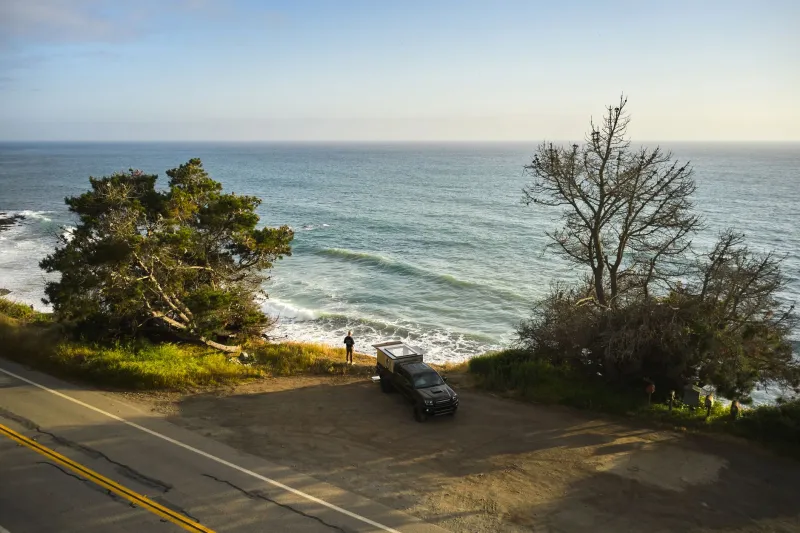
Let's be honest about something. You had a plan.
Maybe it involved golden-hour light hitting the water at exactly the right angle. Maybe it involved sitting cross-legged on a bluff, eyes closed, the ocean doing its thing below, some kind of cosmic download arriving right on schedule. You'd seen the photos. You'd read the testimonials. You knew what a Big Sur breakthrough was supposed to look like.
And then you got here. You hit traffic on Highway 1. You couldn't find parking. Your hiking boots gave you a blister within the first half mile. And somewhere between the trailhead bathroom and the cooler in your trunk, something cracked open inside you — quietly, without fanfare, in the least photogenic moment of your entire trip.
Welcome to the real retreat.
The Tyranny of the Peak Experience
There's a concept in psychology called the "peak experience" — Abraham Maslow's term for those rare, transcendent moments of clarity and connection that feel almost mystical. The wellness industry has quietly turned this into a product. Buy the right retreat package, stand in the right spot, follow the right itinerary, and your peak experience will be delivered like room service.
The problem is that the mind doesn't actually work that way. Insight is slippery. It doesn't respond to pressure or scheduling. In fact, the harder you chase it, the more reliably it hides.
Psychologists who study the mechanics of sudden realization — sometimes called the "aha moment" — have found that these shifts tend to happen not during intense focus, but during relaxed, diffuse mental states. Walking to the car. Waiting for water to boil. Staring out the window at nothing in particular. The brain, when it's not straining toward an outcome, finally has room to make the connections it's been trying to make all along.
Big Sur can create those conditions. But not necessarily in the ways the brochure suggests.
What the Parking Lot Is Actually Doing to You
Here's what happens when you arrive somewhere like this. You've been in a car, probably for hours, probably half-listening to a podcast about the exact kind of healing you're about to go find. Your nervous system is still humming at highway speed. Your brain is still in logistics mode — did I pack sunscreen, what time does the trail close, is this the right lot.
And then you step out of the car.
The temperature changes. The smell hits you — salt, pine, something green and living. The sound of the highway fades and something older takes its place. Your body starts to downshift before your brain even registers what's happening.
That transition — that exact, unglamorous moment of stepping out of your ordinary life into something else — is not the preamble to the healing. It often is the healing. The nervous system doesn't need a cliffside ceremony. It needs the contrast. It needs the moment where the grip loosens.
Some people cry in the parking lot at Big Sur. Not because they're standing somewhere beautiful. Because they just drove four hours while holding everything together, and they finally stopped moving, and the coast didn't ask them to perform.
The Expectation Trap and How It Blocks the Very Thing You Came For
There's a particular kind of spiritual disappointment that's very American. It goes like this: you invest in an experience — financially, emotionally, logistically — and then you monitor it relentlessly to make sure it's working. You're meditating, but you're also evaluating your meditation. You're hiking, but you're also checking whether the hike feels meaningful enough.
This is the expectation trap. And it's especially cruel in places like Big Sur, where the scenery is so genuinely extraordinary that you feel like you should be having a profound experience at every turn. When the profundity doesn't arrive on cue, people feel like they failed the retreat. Like they're doing it wrong. Like they're somehow immune to beauty.
You're not immune. You're just watching yourself too closely.
The moment you stop auditing the experience — stop checking whether it's working, stop trying to manufacture the feeling — is usually the moment something real shows up. And that moment often looks embarrassingly ordinary. You're eating a granola bar. You're reading a trail sign. You're watching a ground squirrel do absolutely nothing interesting near a rock.
And then, without warning, something in you goes quiet. And in that quiet, you hear whatever you came here to hear.
Meaning Doesn't Care About Aesthetics
One of the quieter teachings of any time spent in wild places is that meaning is not aesthetic. The redwoods don't know they're majestic. The fog doesn't know it's atmospheric. The coast is not performing for you. It's just doing what it does — relentlessly, indifferently, without any investment in whether your trip was worth the drive.
That indifference is actually a gift. It means you don't have to be in the right place at the right time with the right lighting. The conditions for transformation are not that specific. They're available in the parking lot. They're available when the trail is muddy and your phone is dead and the viewpoint is fogged in.
The spiritual traditions that have always been rooted in land — including the Esselen and Ohlone peoples whose relationship with this coastline goes back thousands of years — understood something that modern wellness tourism often misses: the sacred is not concentrated in the scenic overlooks. It's distributed through everything. The ordinary and the extraordinary are not separate categories. They're the same ground.
How to Actually Let Big Sur Work on You
Stop waiting for the moment. That's the whole practice, really.
Show up. Get out of the car. Let yourself be wherever you are — tired, disappointed, overwhelmed, underwhelmed, distracted. Don't try to fast-forward to the version of yourself who already had the breakthrough. That person is not ahead of you on the trail. They're standing right here, in the parking lot, holding car keys and a reusable water bottle, slightly sunburned.
Notice what's actually happening in your body right now. Not what you want to be feeling — what you're actually feeling. The slight loosening in your chest. The way your shoulders dropped half an inch when the wind came through. The small, quiet fact that you made it here, to this strange and beautiful edge of the continent, even when everything in your ordinary life was pulling you to stay put.
That noticing? That's the practice. That's the retreat.
The clifftop is lovely. The sunset will be stunning. But the epiphany — if it comes — will probably arrive when you're not looking for it. When you've stopped performing your healing and just let yourself be a person standing somewhere wild, doing the best you can.
Which, it turns out, is more than enough.