These Rocks Are Older Than Your Stress: What Big Sur's Ancient Stone Actually Does to Your Body
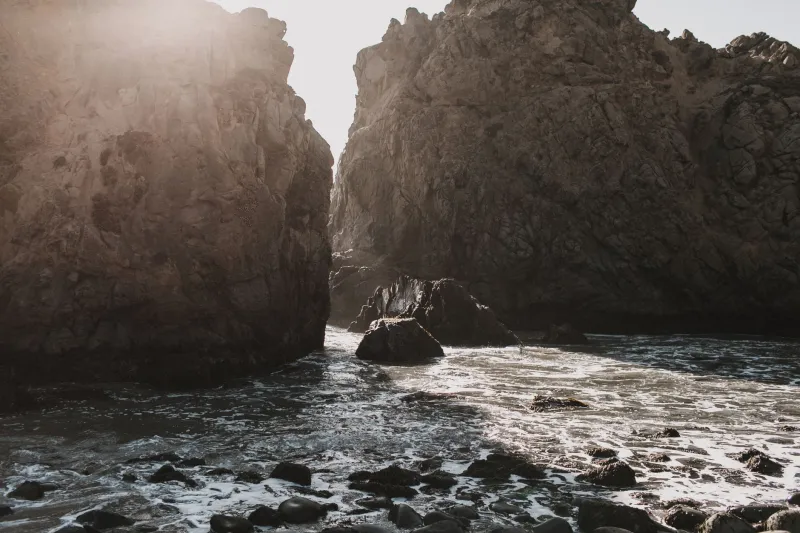
There's a particular kind of quiet that happens when you press your palm flat against a sun-warmed granite face somewhere along the Big Sur coast. It's not the silence of a library or a meditation app. It's something older and a little harder to explain — like the rock is doing something back.
That sensation is easy to dismiss. We live in a culture that's pretty quick to call anything it can't immediately quantify "woo." But researchers studying biofield interactions, trace mineral absorption, and grounding physiology are starting to ask questions that take that feeling seriously. And when you understand what Big Sur's geology actually is — what it's made of, how old it is, where it came from — the idea that standing on it might change something in your body starts to feel a lot less far-fetched.
What You're Actually Touching When You Touch These Cliffs
Big Sur sits on one of the most geologically complex strips of land in North America. The Santa Lucia Range — those steep, dramatic ridges that drop almost straight into the Pacific — is built from rocks that formed over 100 million years ago. You've got ancient granite batholiths, deep-ocean serpentinite, and some of the only naturally occurring nephrite jade deposits in the continental United States, concentrated around Jade Cove near Gorda.
Each of these rock types carries a distinct mineral signature. Granite is rich in quartz, feldspar, potassium, and trace amounts of magnesium. Serpentinite — that greenish, waxy rock you'll see threading through the hillsides — is loaded with magnesium, iron, and silica, and it forms from oceanic crust that's been through enormous heat and pressure. Jade (nephrite specifically) is a dense calcium-magnesium silicate that's been prized in healing traditions across Asia and the Americas for thousands of years.
These aren't just aesthetic differences. Mineralogically speaking, this is a landscape that reads like a full-spectrum supplement.
The Science of Skin-to-Stone Contact
Lithotherapy — the use of stones and minerals for healing — tends to get lumped in with crystal healing and dismissed wholesale. That's a little too quick. There are legitimate physiological mechanisms worth examining here.
First, there's transdermal mineral absorption. While your skin is a barrier, it's not an impermeable one. Research into magnesium absorption through skin contact (particularly from mineral-rich water and topical applications) suggests that the body can take in trace minerals through prolonged skin contact with mineral-dense surfaces. Magnesium in particular is chronically deficient in most American adults — and it's fundamental to over 300 enzymatic reactions in the body, including those involved in stress response, sleep, and muscle function. Serpentinite and granite are both high-magnesium formations. Sitting against them for an hour isn't a supplement, but it's not nothing either.
Second, there's the grounding effect — sometimes called earthing. A growing body of research, including peer-reviewed studies published in journals like the Journal of Inflammation Research and Health, has examined what happens when the human body makes direct electrical contact with the earth's surface. The earth carries a mild negative charge. Most of us spend our days insulated from it by rubber-soled shoes and synthetic flooring. When you make barefoot or bare-skin contact with rock or soil, your body can absorb free electrons from the earth's surface — and this appears to have measurable anti-inflammatory effects. Your cortisol rhythm normalizes. Inflammatory markers decrease. People report sleeping better within days of consistent grounding practice.
Big Sur's exposed rock faces — especially along the coastal trail access points and the beaches below — offer direct, unmediated contact with some of the most electrically conductive geological material on the West Coast.
Why Ancient Stone Hits Different
There's something worth sitting with here that goes beyond the biochemistry. The rocks at Jade Cove have been tumbled and compressed and heated over timescales that make human civilization look like a blink. The granite in the Santa Lucias crystallized from magma when the continent was still figuring out its shape.
Some researchers working at the intersection of ecology and psychology — including work building on E.O. Wilson's biophilia hypothesis — suggest that humans have a deep, evolutionarily-encoded response to ancient, stable geological formations. Our nervous systems may recognize something in the permanence of stone that triggers a parasympathetic shift: a move out of fight-or-flight and into rest-and-digest. This isn't mysticism. It's the body doing pattern recognition, finding a signal in the environment that says this has been here a long time and it is not a threat.
In a nervous system that's been running on high alert since before you even noticed, that signal matters.
How to Actually Use This
You don't need a retreat booking or a guided ceremony to access what Big Sur's geology offers. Here's what intentional stone contact can look like in practice:
Sit against the rock, not just near it. Full back contact with a large granite or serpentinite formation gives your body the most surface area for both thermal exchange and potential mineral interaction. Even 20 minutes has measurable effects on cortisol according to some nature-immersion studies.
Go barefoot on the stone beaches. The jade and granite pebble beaches along the southern Big Sur coast are ideal for grounding practice. The stones are smooth, the contact is direct, and the sound of the surf adds an acoustic grounding layer that amplifies the parasympathetic response.
Hold what you find — carefully and ethically. Jade Cove is a State Marine Conservation Area, so removing jade is prohibited. But holding a stone you find on the beach (and returning it) gives your hands — which are extraordinarily sensitive to texture, temperature, and mineral composition — a chance to register what the rest of your body might be missing.
Stay longer than feels comfortable. Most of us are conditioned to move through natural spaces quickly, checking them off a list. The mineral and grounding effects that researchers are documenting tend to require sustained contact — 30 minutes minimum, ideally longer. Bring water. Bring nothing that needs charging.
The Land as Medicine Cabinet
Indigenous Ohlone and Esselen peoples lived in relationship with this land and its mineral-rich geology for thousands of years before it became a destination. Their healing traditions included stone-based practices that contemporary science is only beginning to examine through its own frameworks. That context matters. It's a reminder that what feels like a new discovery is often a very old understanding, finally getting the research it deserves.
Big Sur's rocks aren't inert backdrop. They're ancient, mineral-dense, electrically active formations that your body — at a cellular level — already knows how to respond to. You just have to get close enough to let it happen.
Put your hand on the cliff. Stay a while. Something older than your stress is already at work.