Loneliness Has a Scent — And Big Sur's Coastal Air Is the Antidote Your City Never Had
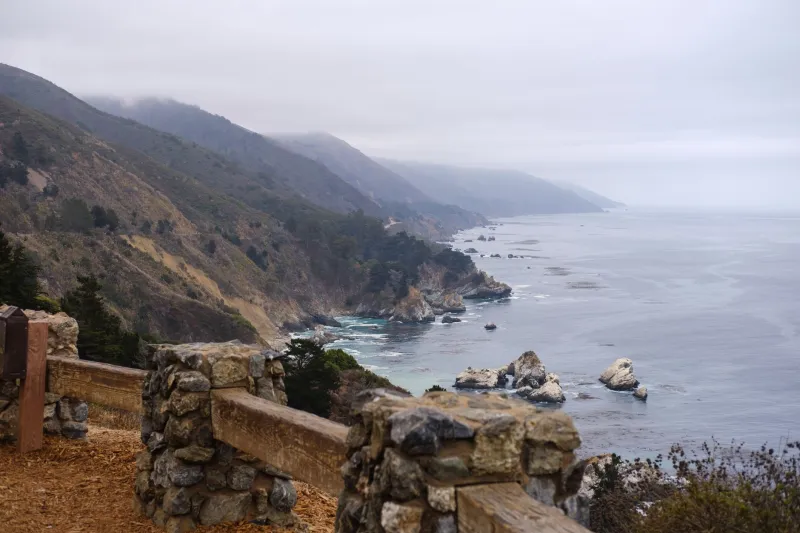
Something happens when you step out of the car at Big Sur for the first time. Before you see the cliffs, before you hear the surf, before your brain has had a chance to catch up with where your body actually is — you smell it. Salt, sage, something green and dark underneath, something almost sweet. And something in you, some old animal part, goes: oh. This.
That response is not poetic. It is neurobiological. And the fact that most of us spend our lives in environments that never trigger it has more to do with the loneliness epidemic than we've been willing to admit.
Your Nose Is a Social Organ
Here's something most people don't know: the olfactory system is the only sensory system with a direct, unfiltered line to the limbic brain — the part of you that processes emotion, threat, attachment, and belonging. Every other sense has to transfer through the thalamus first, which acts as a relay station. Smell bypasses all of that. A scent molecule enters your nose and lands directly in structures responsible for whether you feel safe, whether you feel connected, whether you feel like you are somewhere that wants you.
Researchers studying social isolation have found that loneliness doesn't just change how people think — it changes how they smell, and how they perceive smell. Chronically isolated individuals show measurable changes in olfactory processing, including reduced sensitivity to the kinds of environmental compounds associated with safety and social warmth. The brain, essentially, starts tuning out the world. Not because it's broken. Because it's protecting itself.
And in cities, there isn't much to tune into anyway.
What Urban Air Is Actually Doing to You
City air isn't just polluted in the obvious way — particulate matter, ozone, exhaust. It's also chemically impoverished in ways that don't make headlines. The volatile organic compounds (VOCs) that plants release — the terpenes, the phytoncides, the earthy microbial exhalations — are largely absent from urban environments. The soil microbiome that would normally be producing compounds like geosmin, the molecule responsible for that after-rain smell, is buried under concrete or so degraded it can barely function.
What this means, practically, is that your olfactory system is running on empty. It's scanning constantly for chemical signals that would tell your nervous system where it is, whether it's safe, whether there are other living things nearby — and it's coming up with mostly nothing. Or worse, with the chemical signature of stress: exhaust, synthetic fragrance, the particular acrid flatness of recycled indoor air.
Over time, that olfactory deprivation isn't neutral. It contributes to what researchers describe as a kind of ambient low-grade threat response — a baseline hum of unease that most city dwellers have learned to call normal.
Big Sur's Specific Chemistry
The Central Coast is not just pretty. It is, from a microbiological perspective, extraordinarily chemically active.
The marine layer that rolls in off the Pacific carries aerosols laden with sea salt, marine bacteria, and trace minerals. Those aerosols have been shown to have measurable effects on mood and respiratory function — partly through negative ion content, partly through microbial exposure that primes the immune system, and partly through compounds like dimethyl sulfide, which the ocean produces in abundance and which the human brain appears to respond to in ways scientists are still working to fully understand.
Above the waterline, the chaparral and coastal scrub release a near-constant stream of terpenes — alpha-pinene from the conifers, camphor and cineole from the sage, limonene from the coastal shrubs. These aren't just pleasant smells. Alpha-pinene has been shown in multiple studies to reduce anxiety and increase alertness. Cineole crosses the blood-brain barrier and affects acetylcholine pathways. The soil in the redwood canyons just inland is teeming with Mycobacterium vaccae, a bacterium whose compounds appear to trigger serotonin release when inhaled or ingested.
Your body, walking through Big Sur, is being chemically briefed. You are in a living system. You are not alone. The world is full.
Why This Feels Like Coming Home (Even If You've Never Been)
One of the stranger things people report when they arrive at Big Sur — especially people who grew up in cities, who have no particular history with wild coastlines — is a feeling of recognition. Not nostalgia exactly. Something older than that. A sense of familiarity that doesn't attach to any specific memory.
That feeling has a plausible biological explanation. Human nervous systems evolved in environments that smelled like this — like living soil, like the sea, like green things metabolizing in sunlight. The olfactory system carries deep evolutionary memory. When it finally receives the chemical signals it was shaped to receive, something settles. Not because the place is familiar. Because the chemistry is.
Loneliness, at its root, is often described as a feeling of not belonging — of being somehow outside the fabric of things. What Big Sur's air does, on a neurochemical level, is temporarily dissolve that boundary. You are breathing in a living system. The living system is, quite literally, inside you.
You Can't Fully Replicate This at Home (But You Can Get Closer)
Essential oil diffusers are not the same thing. That needs to be said plainly. A synthetic pine scent in your apartment does not carry the microbial complexity, the marine aerosols, the soil-based compounds that make Big Sur's air what it is. But there are meaningful steps that close the gap.
Spending time in any green space with actual soil — not just manicured lawns, but places where things are decomposing, where the dirt is dark and alive — exposes you to soil microbiome compounds that your immune system and nervous system genuinely respond to. Coastal access, even a day trip, provides marine aerosol exposure that can shift your baseline. Opening windows in the morning when air quality is better, keeping living plants (especially those that release terpenes, like rosemary and lavender), and reducing synthetic fragrance that overwhelms and desensitizes your olfactory system — all of these matter.
But the honest answer is that some things require the place itself. Some healing is site-specific. Big Sur's microbiome is the result of millions of years of ecological layering — the redwoods, the chaparral, the kelp forests offshore, the particular fog patterns of the Central Coast. It is not a formula you can import.
The Loneliness Epidemic Is Also an Ecology Problem
We spend a lot of time talking about loneliness as a social failure — a result of too much screen time, not enough community, the atomization of modern life. All of that is real. But there's an ecological dimension we almost never discuss: we have cut ourselves off from the chemical environments that tell our nervous systems we are embedded in something larger than ourselves.
Big Sur doesn't fix loneliness because it's beautiful, though it is. It doesn't heal because it's quiet, though the quiet matters. It heals, in part, because it fills your nose with the smell of a living world, and your ancient, animal brain finally gets to exhale.
You were never meant to be this odorless. Neither was the world around you.