Something Has to Rot First: What Big Sur's Forest Floor Knows About Falling Apart
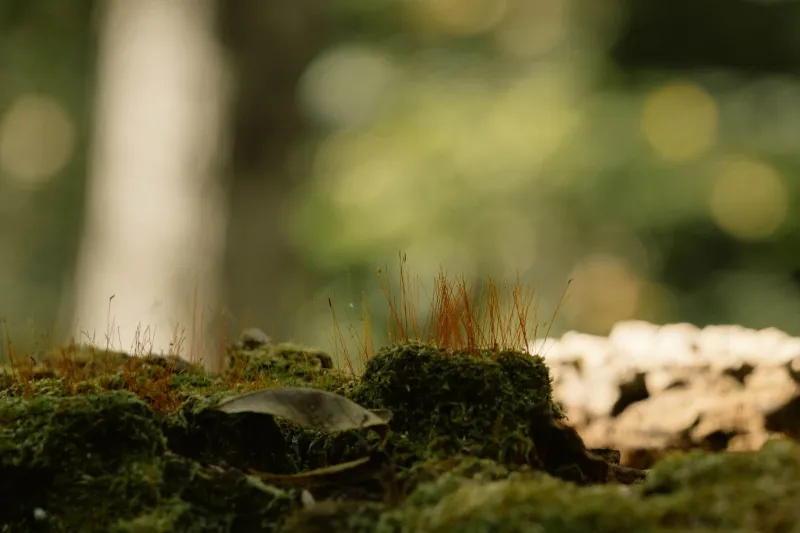
There's a moment on the trail through Big Sur's redwood canyons where you stop and notice what's underneath everything. Not the towering trunks or the cathedral light filtering through the canopy — but the ground itself. The soft, dark, half-dissolved world of fallen logs and leaf litter and things you can't quite identify anymore because they're in the middle of becoming something else entirely.
It smells alive in a way that's hard to describe. Rich, earthy, a little bit like something ending. And also, unmistakably, like the beginning of something.
That's decomposition. And it might be the most honest metaphor for emotional healing that nature has ever offered us.
The Culture That's Terrified of Rotting
We live in a wellness landscape obsessed with upward trajectories. The arc of healing, as most self-help culture frames it, is supposed to move consistently forward — grief becomes acceptance, trauma becomes growth, breakdown becomes breakthrough. There's a timeline implied in all of it. A finish line.
But if you've ever sat with real grief, or worked through something that cracked you open at the foundation, you know it doesn't move in a straight line. It moves the way decomposition does: slowly, messily, sometimes backwards, often invisible. You think you've processed something and then it surfaces again, darker and weirder than before. You feel worse on Tuesday than you did last month. Something you thought was behind you is suddenly right in front of your face, and it smells.
We tend to interpret that as failure. As regression. As proof that we're doing it wrong.
Big Sur's forest floor would like to respectfully disagree.
What Decomposition Actually Does
In ecological terms, decomposition isn't the opposite of growth. It is growth, just running in a direction we're not trained to celebrate. When a redwood falls in the Santa Lucia Mountains, it doesn't disappear — it enters a transformation that can take decades. Fungi thread through the wood, bacteria colonize the softening fibers, beetles and millipedes and organisms you'd need a microscope to see all begin their patient, essential work.
The log loses its shape. It gets dark and soft and unrecognizable. And in doing so, it releases everything it was holding — carbon, nitrogen, phosphorus, moisture — back into the system that needs it. The next generation of trees literally grows from what the old one gave up by falling apart.
This isn't a poetic stretch. It's chemistry. It's biology. The breakdown is the mechanism. You cannot skip it and get the nutrients.
Now think about what you're carrying.
The Intelligence Inside the Mess
Emotional processing, the kind that actually changes you rather than just managing you, requires something similar. The hard feelings have to be metabolized, not bypassed. Grief, anger, shame, fear — these aren't obstacles to healing. They're the material of healing, the organic matter that has to break down before it can feed anything new.
When you cry in your car for no reason you can name. When an old wound resurfaces during a walk on a Big Sur beach and you feel like you've lost all the ground you thought you'd gained. When the therapy session leaves you feeling worse than when you walked in. That's not regression. That might be active decomposition. The system is working.
The problem is that we're not taught to recognize intelligent dissolution. We're taught to fix, to stabilize, to perform okayness. So when we're in the soft, dark, unrecognizable phase — the phase where we don't look like ourselves anymore, where things feel like they're falling apart — we panic. We reach for something to stop the process.
And we interrupt the very thing that was about to feed us.
Big Sur as a Classroom in Letting Things Break Down
There's a reason people come to this coastline to fall apart. Not everyone admits that's why they came. They say they needed a vacation, or fresh air, or perspective. But Big Sur has a way of stripping the performance layer off fairly quickly. The scale of it — the cliffs, the fog, the ocean that doesn't care even a little bit about your schedule — has a way of making the thing you've been holding at arm's length suddenly feel very close.
And then the land holds it. That's the part that surprises people.
The canyon doesn't rush you. The fog doesn't ask you to look on the bright side. The soil underfoot has been in the business of patient transformation for longer than human civilization has existed. When you sit with that, something in your nervous system starts to take notes.
You can actually feel the difference between being in a place that demands your composure and being in a place that simply witnesses your process. Big Sur, at its best, is the latter.
Slowing Down the Breakdown (So It Can Actually Work)
Here's the counterintuitive part: decomposition works faster when you stop trying to speed it up. Compacted soil with no air, no moisture, no microbial activity — that's where organic matter just sits, inert, not going anywhere. The conditions for transformation require a certain kind of spaciousness.
The same is true for emotional processing. The healing doesn't accelerate when you push harder. It accelerates when you create conditions where the breakdown can proceed without interference — space, witness, some willingness to be in the uncomfortable in-between without immediately trying to resolve it.
That might look like sitting with something without journaling it into a lesson yet. It might look like letting yourself be sad without asking what the sadness is for. It might look like taking a walk through the redwoods and not trying to extract a takeaway from the experience, just letting the damp air and the smell of the forest floor do whatever they're going to do to your nervous system.
Sometimes the most productive thing is to just let the rot happen.
You Are Not Behind Schedule
If you're in a hard season right now — if something in you feels like it's breaking down rather than building up — the forest floor has a message for you. Not a comforting platitude. Something more solid than that.
The breakdown is not the problem. The breakdown is the process. The messy, unrecognizable, takes-longer-than-you-thought dissolution of what you were is how the nutrients get released for what you're becoming. There is no shortcut through it. There is no version of this where you skip the rot and go straight to the regrowth.
Big Sur's canyons have been running this experiment for millennia. The fallen trees don't apologize for taking decades to transform. They just do the work, slowly and completely, and eventually — eventually — something new grows out of exactly where they fell.
You're allowed to take that long too.