The Night Sky Used to Be Medicine: How Blue Light Broke Our Oldest Healing Ritual and What Big Sur Can Teach Us About Getting It Back
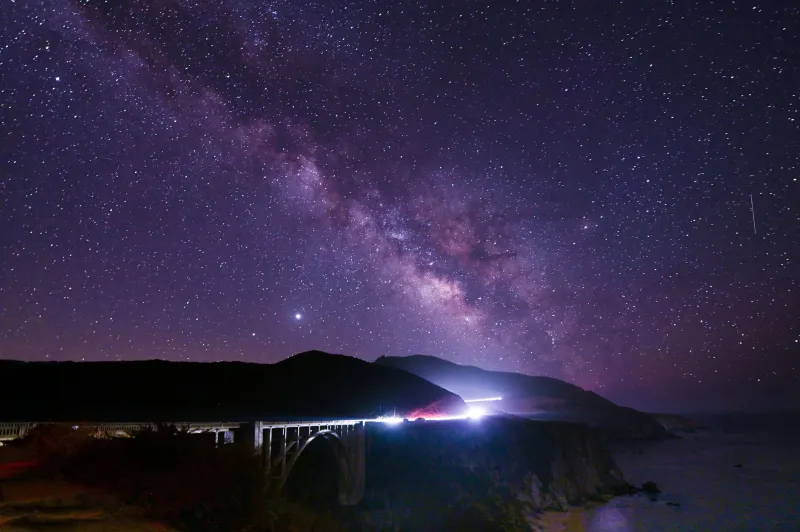
Somewhere along the way, we decided the night was a problem to solve.
We lit it up. We filled it with screens and streetlights and the ambient glow of cities that never actually sleep. And in doing so, we quietly dismantled one of the most ancient healing systems our bodies have ever known — the ability to exist inside true, uninterrupted darkness and read the sky above us.
Stand on the bluffs south of Pfeiffer Beach on a clear night and you'll understand immediately what's been missing. The Milky Way isn't a concept out here. It's a physical presence — a dense, luminous river draped across the whole dome of the sky. Your eyes, if you give them time, will begin doing something they almost never get to do anymore: they'll actually open.
What Your Eyes Are Designed to Do in the Dark
Human vision operates through two main systems. Cone cells handle color and detail in bright light. Rod cells — far more numerous and distributed across the peripheral retina — are built for low-light conditions. They're exquisitely sensitive to motion, contrast, and the faint luminosity of stars.
Full dark adaptation takes roughly 20 to 45 minutes. During that process, your pupils dilate, your rod cells regenerate a light-sensitive pigment called rhodopsin, and your visual cortex gradually shifts its processing priorities. It's a whole-system recalibration — and it's one that most Americans never complete, because we're almost never in the dark long enough.
The average American adult now spends over 11 hours a day in front of screens. Blue-spectrum light — the wavelength that phones, tablets, and LED fixtures emit most aggressively — is particularly disruptive to rhodopsin regeneration. It doesn't just slow down dark adaptation. It actively signals your brain that it's noon.
Your nervous system, trying to make sense of conflicting information, stays stuck in a low-grade state of alertness. Melatonin suppression isn't just a sleep issue — it's a full-body hormonal disruption that touches immune regulation, mood, metabolic function, and the kind of deep nervous system repair that can only happen in true physiological night.
The Evolutionary Argument for Stargazing
This isn't nostalgia. This is neuroscience with a very long timeline.
For the vast majority of human evolutionary history, nighttime darkness was unavoidable and meaningful. Our ancestors didn't just endure the dark — they used it. They navigated by stars, tracked lunar cycles for planting and ritual, told stories that encoded ecological knowledge into constellations, and experienced a quality of rest that modern sleep science is only beginning to understand.
The Esselen and Ohlone peoples who have called this stretch of the California coast home for thousands of years understood the night sky as a living map and a sacred text. The darkness wasn't empty. It was full of information, relationship, and medicine.
When we talk about light pollution stealing our night vision, we're not just talking about astronomy. We're talking about severing a sensory and spiritual connection that is genuinely ancient — one that the body still expects, still reaches for, and still suffers without.
What Happens When You Actually Sit in Big Sur's Dark
Visitors to Big Sur often report something unexpected on their first clear night here: a kind of emotional opening that accompanies the visual one.
There's a reason for that. The experience of genuine darkness — not the gray-black of a suburban bedroom, but the velvety, dimensional dark of a coastline with no city glow on the horizon — activates the parasympathetic nervous system in ways that feel almost immediately different from ordinary relaxation. Your breathing slows. Your jaw unclenches. Your sense of the scale of things shifts in a way that tends to make personal anxieties feel, if not smaller, then at least more proportionate.
Researchers studying awe — that specific emotional state triggered by vastness, beauty, and things larger than the self — have found that it measurably reduces inflammatory cytokines, lowers cortisol, and increases prosocial behavior. A sky full of stars, it turns out, is a surprisingly efficient delivery mechanism for awe.
And you don't have to earn it. You just have to stay outside long enough for your eyes to adjust.
Practical Ways to Reclaim Darkness at Home
You can't bring Big Sur's sky back to your apartment in Denver or your house in the suburbs of Atlanta. But you can start rebuilding a relationship with darkness that your nervous system will genuinely thank you for.
Start with a blue light sunset. About 90 minutes before bed, eliminate blue-spectrum light sources. This means phones, laptops, overhead LEDs. Switch to warm amber bulbs, salt lamps, or actual candlelight. This isn't aesthetic preference — it's a biological signal that the day is ending.
Do a 20-minute dark sit. Once a week, go outside after full dark and just sit. No phone. No podcast. Let your eyes adapt. Notice what becomes visible that wasn't visible at first. This practice alone can begin to rebuild your relationship with low-light perception and give your nervous system a rare window of genuine decompression.
Use red light for nighttime navigation. Red-spectrum light has the least impact on rhodopsin and melatonin. Headlamps and nightlights with red settings are widely available and genuinely preserve your night vision in a way that white or blue light never will.
Make your bedroom actually dark. Blackout curtains are one of the highest-ROI wellness investments available. The ambient glow from streetlights and device standby indicators is enough to measurably disrupt melatonin production and sleep architecture. Real dark is a different physiological experience than dim.
Find your nearest dark sky area. Many states have designated dark sky parks or preserves where light pollution is actively managed. A monthly or quarterly trip to one of these locations — or to a stretch of coast like Big Sur — can function as a kind of sensory reset, reminding your body what full darkness feels like and recalibrating your baseline.
The Quiet Radicalism of Turning the Lights Off
There's something quietly countercultural about choosing darkness in a culture that has made perpetual illumination a default setting. We light everything because we can, and because somewhere along the way we started treating darkness as a deficiency rather than a condition.
But the body knows better. The body has always known better.
Out here on the Big Sur coast, when the marine layer lifts and the stars come all the way down to the horizon, it's hard not to feel like you're remembering something. Not learning it — remembering it. Some older, slower, more calibrated version of what it means to be a human animal on a turning planet, oriented by light that traveled millions of years to reach you.
Your ancestors didn't just survive the dark. They found their way by it.
Maybe it's time to let it guide you again.